
Unless you live near vet clinics that see basenji breeders, basenjis are rare enough that a busy practice might see one or two a year. Even Sachi's breeder still observed that most vets tend to view basenjis through a general-domesticated-canine lens. This causes misunderstanding about a basenji's behavior and affect, and in turn, judgment about basenji owners' effort in terms of socializing, training, and general competence with their dogs.
Knowing the rarity of basenjis, and having had poor experiences with another clinic, I wanted to make sure Sachi gets the most informed care with professionals who listened. What I appreciated about our vet is his immediate candor: even with years of experience, our vet admits he rarely sees basenjis. Because of this, he doesn't know much about basenjis versus other popular dog breeds.
Vets rarely have enough "basenji-specific data" to build pattern recognition from clinical volume alone. This means vets rely on me as Sachi's owner to provide information about Sachi's diet, habits, and behaviors to help them formulate clinical insight about Sachi's health. Collaborative vets welcome owners' narrative clinical history about their basenjis. Our vet made an off-hand remark about a dog whose owner is a technical professional and provided graphs about the dog.
I thought, "I can do graphs!"
That same day I planned my "Sachi App". I drafted a framework for data to collect about Sachi's health and habits. I began entering data. As data collection continued, I revised and re-revised the tracker. I conducted deep-dives into scientific literature published (few and far between) about basenjis. I jumped through querying rabbit-holes about basal clade canines. Then I integrated this compiled scientific research into the app.
I tested weekly data output against various AI models, and evaluated where all models overlapped and where specific AI models offered unique insights. As of this writing I'm at version 6 of the app, and still consider this tracker very much "in beta mode". But I can already tell you: When you've met a basenji, you've met ONE basenji.
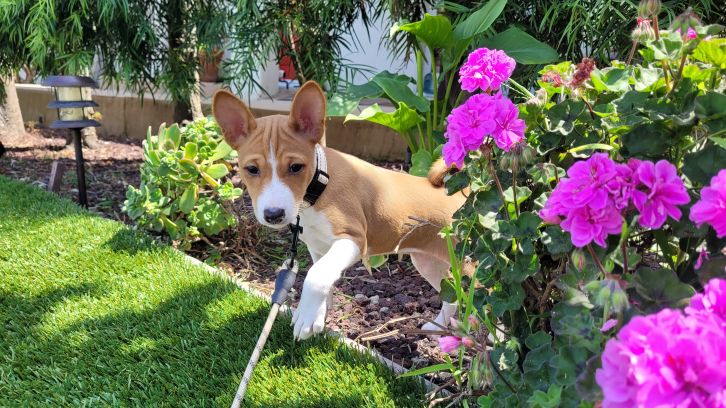
This website shares what I am learning about Sachi basenji.
The three brains
Most basenji information I've read is single-frame: nutrition or training/behavior or veterinary visits. The insights that have helped me better understand Sachi required me to integrate multiple factors, from GI baseline to arousal level to sleep stability.
So when I write about Sachi, I hold all three lenses at once — not because it makes a tidy framework, but because that's what actually understanding her requires.
Dog brain. Sachi basenji as biological organism. Basal-clade phylogeny. IPSID, Fanconi, PRA, PK deficiency as documented breed-specific health concerns. Scavenging as inherited from village-dog ecology.
Owner brain. The owner as observer, logger, and — more uncomfortably — variable. My household is not a neutral container in which Sachi lives. As members of Sachi's "pack," our physical location, attentional state, and emotional baseline become inputs and part of the data understanding Sachi.
Vet brain. The translation layer. What our cross-sectional veterinary clinician needs to make the best decision about Sachi in the exam room. I want to bring data the vet can actually use without relying on my narrative memory.
What this site is and isn't
This site is one household's mostly consistent observation of one basenji, interpreted against published scientific literature about basenjis and basal clade primitive canines.
Boundaries
- close It is not a substitute for veterinary care.
- close It is not a generalized basenji/breed guide.
- close It is not me telling you what to feed, train, or worry about.
These are field notes of a scientist applying investigative mindset to her first basenji. The methodology is the point. Sachi is the n=1.