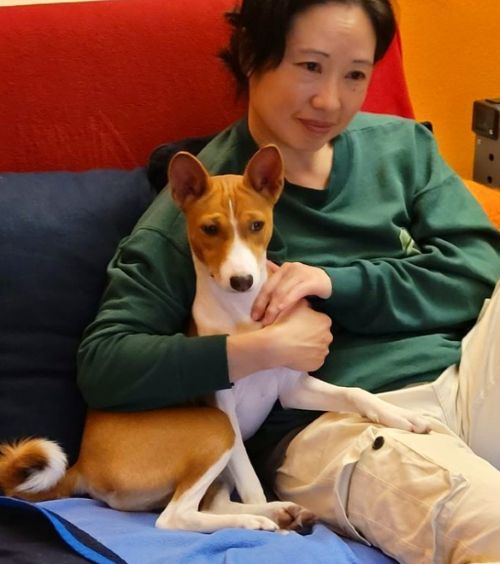
WHY is Sachi’s poop so inconsistent! One poop would be amazing. Solid. Well-formed. Easy clean-up. Later, same walk, Sachi is dropping soft-serve-turds along the pavement as I silently groaned about how many poop bags and tissue paper I’d need for a proper clean-up of her work. Worse yet! My Husband does the walking! Then I’m on edge at home wondering if he’s going to text me photographic evidence with, “Did you give her any new treats?!”
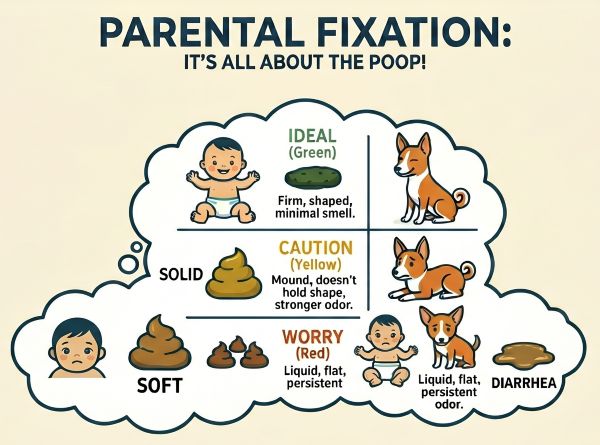
When our kid was a newborn I kept logs of his feeding and poop activity. Our basenji is giving me deja vu, or rather, I was on a quest to figure out what’s going on with our basenji’s GI. She seems otherwise healthy, energetic, and appetite-normal (never picky or refuses food).
I Need a Baseline of Key Metrics.
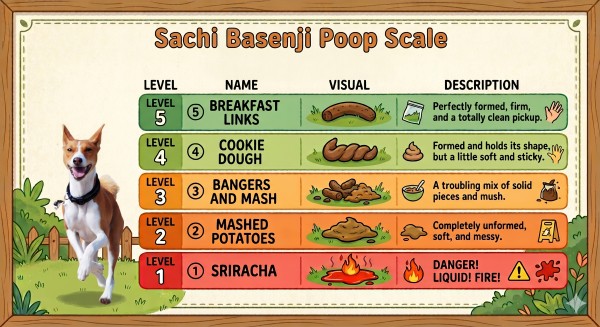
To start, I needed data for her baseline. I identified variables I wanted to track about Sachi’s health. Within the week I’d already revised and updated the health tracker a dozen times. Should overnight sleep be grouped with observed rest during the day? Do I want to differentiate between Sachi being anxious, curious, or clingy? Should the poop 1-to-5 scale be separate from “diarrhea”?

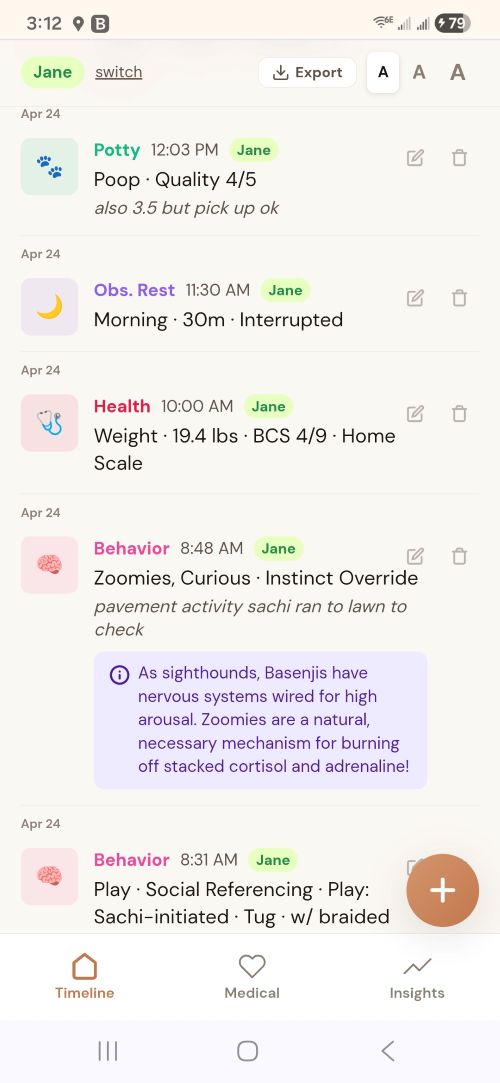
The problem with trying to capture too much data is that I end up with large volumes of data “noise” . Across key topics, I was collecting almost 600 data points within 1 month, and I wondered how many important needles I was losing among the bales of haystacks. I had to pick certain data to ignore in the analysis, or not collect at all. The tracker went from bare to bloat and is now “strategically streamlined”... I think.
I am an “Owner-Variable”.
Basal clade “primitive” breeds like basenjis didn't co-evolve with humans the same way labradors or golden retrievers did . This means a basenji's “social reference” behavior occurs less than most domestic working breeds. They're not constantly checking human faces for cues. But this does not mean basenjis are not tracking “their” humans obsessively. I realized that I was tip-toeing around my own house to avoid “tripping” Sachi’s alert-wires and she’d sprint zooming from the outside lawn into the house to investigate why I have moved my position.
This means that I am, in her assessment, a key asset for her survival. Particularly where food is involved. She has logged this fact and adjusted her behavior accordingly. Which means my behavior: my location, routine, attentional state, whether I'm wearing fleece pants (“house”) or changed into stretch leggings (“climbing gym?!”) is a new alert in Sachi’s brain.
Even owners within the same household can interact very differently with the same basenji, and interpret the same basenji signals differently. Early in the data analysis, one of the AI models I used noticed that my husband never appeared to score Sachi’s poop quality “5/5”, versus my score trends. This called for a meeting where my husband and I discussed Sachi’s poop rank so we’d be on the same page.
I Almost Forgot Actual Science Research
In our quest for deciphering various aspects of Sachi’s gut health and behaviors, we spent an enormous amount of time in internet forums looking for answers. Someone's basenji did this weird thing with food. Someone else's basenji had this behavior that sounded familiar. I was triangulating from other people's observations of their own n=1s (more weight if they’ve owned multiple basenjis over decades), trying to find something that mapped onto my n=1. Sachi’s breeder is always generous with tips and advice when I contact her.
Meanwhile: there is actual published scientific literature about basenjis. There is research on basal clade primitive canines, which is the broader group of ancient domesticated breeds that basenjis belong to. I forgot to conduct actual scientific literature… as a scientist. When a subject gets too close and personal, even a scientist can forget “to science”. Forums felt faster and affirming (“See? Other people, even non-basenji dog owners, struggle with inconsistent dog poop! I’m not a bad owner failing her basenji.”).
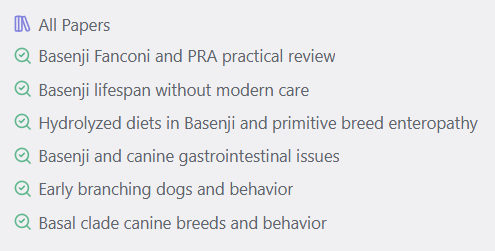
I figured if I wanted to truly understand Sachi’s health, I should gain a better understanding of what’s already known and published by veterinary- and scientific professionals.
When You’ve Met a Basenji, You’ve Met One Basenji.
The most important epistemic boundary of this entire project: everything here is one household's observation of one basenji. I now understand that I wasn’t gaining certainty. I was producing a better-documented version of what I don't know. This is how I am learning about Sachi basenji.