
I. The Bottom Line: Focus was on Inherited Diseases
The basenji research record is most rigorous around breed-specific inherited disease programs. Work around modern population-level data and behavioral studies remains thin. Because of the sparse research with basenjis, cross-referencing with available research with other basal-clade, primitive breeds may be helpful.
- The overall basenji research record is real but uneven, clustering heavily around a few inherited diseases.
- Data should be categorized into direct health/trait evidence and indirect ancestry context rather than being treated as a flat list of facts.
- Popular behavioral descriptions, like the “cat analogy,” are convenient quick-explainers for owners like me; these are not meant to represent formal research evidence of weak attachment or quasi-wildness.
II. Highest Confidence Findings
The strongest evidence in the basenji literature anchors on a short list of well-characterized inherited diseases and a couple of breed-specific physiological signatures. These are the places where decades of clinical work, molecular genetics, and population data converge — the findings that owners, breeders, and vets can act on with the most confidence.
Genetic and Clinical Diseases
A short list of inherited diseases anchors nearly all of the strongest basenji-specific evidence. Fanconi syndrome and pyruvate kinase deficiency both have decades of clinical literature now backed by confirmed genetic causes and DNA testing. Eye conditions and immunoproliferative enteropathy round out the breed disease cluster, though with varying degrees of molecular clarity.
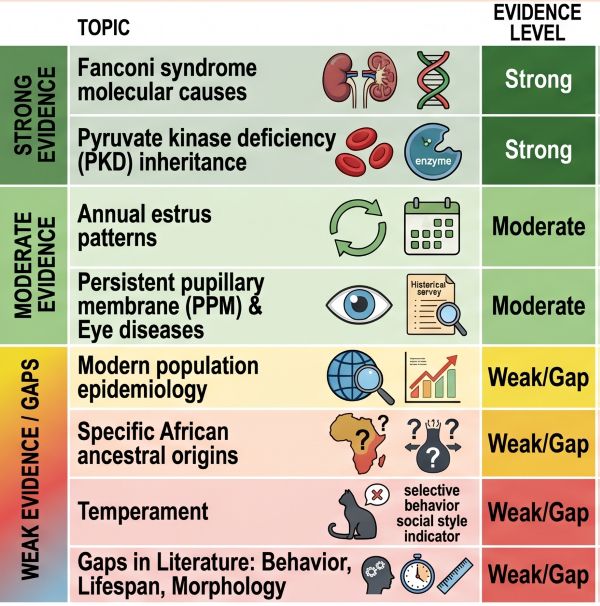
- Fanconi Syndrome: the clearest bridge from phenotype to a specific molecular cause in the breed. Researchers have identified near-complete genotype-phenotype concordance with a 317 base pair FAN1 deletion. Onset is confirmed to be late, typically presenting between 4 to 7 years of age in the recent molecular cohort. [Note: Syndrome was named after Swiss pediatrian Guido Fanconi (1892–1979), who described the renal tubular defect in children in 1931.]
- Pyruvate Kinase Deficiency (PKD): supported by a clear, long-running literature base covering its autosomal recessive inheritance and DNA testing.
- Ocular (Eye) Conditions: persistent pupillary membrane (PPM) is a well-documented historical concern. Late-onset retinal degeneration (PRA) is strongly linked to an autosomal recessive SAG (S-antigen gene = SAG) mutation.
- Immunoproliferative Enteropathy: a recognized breed disease characterized by chronic diarrhea and weight loss, though its exact pathogenesis remains less settled than Fanconi or PKD. Immunoproliferative small intestinal disease (IPSID) may also be used to describe this disease in basenjis. While IPSID is used for humans, current literature supports Basenji IPSID as a historical comparative analogy with partial clinicopathologic overlap, not a demonstrated cross-species equivalent of human IPSID.
Baseline Breed Traits
Beyond disease, two breed-specific physiological signatures are well-documented enough to rely on clinically: an annual reproductive cycle that is unusual among domestic dogs (but common in basal clade primitive canines), and adult blood values that drift from generic canine reference ranges. Both matter in practice because using mainstream dog norms can lead to misreads in basenjis specifically.
- Reproductive Seasonality: basenjis possess a highly unusual, real annual estrus pattern. Pedigree data from Australia indicates that while seasonal breeding is the norm, a dominant non-seasonal breeding allele exists with incomplete penetrance.
- Hematology: adult basenjis display normal hematologic values that differ from generic canine reference ranges.
III. Comparative Insights: Learning from Other Primitive Breeds
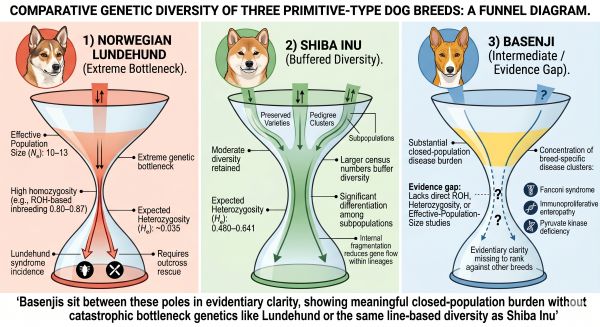
Because direct genomic diversity studies in basenjis are still missing, useful inferences come from reading the breed against others with similar primitive lineage and closed-population history. Two primitive breeds bracket the spectrum: the Norwegian Lundehund as a worst-case bottleneck, and the Shiba Inu as a more buffered example of preserved diversity.
Why Comparisons Are Necessary
The basenji clearly carries the disease pattern of a closed population, but no published study yet measures the breed’s actual genome-level inbreeding load. Until that data exists, the most honest way to estimate where basenjis sit on the bottleneck spectrum is to read them against breeds that have been more thoroughly genotyped.
- Basenjis show a clear concentration of breed-linked inherited diseases typical of a closed population.
- Direct, basenji-specific genomic severity metrics — like Runs of Homozygosity (ROH) or exact effective population size — are missing from the current literature.
- Researchers must look to other primitive types to benchmark the extremes and buffers of genetic bottlenecks.
The Norwegian Lundehund (Extreme Bottleneck Model)
The Lundehund is a cautionary worst-case for primitive-breed genetics. With an effective population size in the low double digits and roughly 87% of the autosomal genome locked in homozygous runs, the breed has reached a point where formal outcrossing is treated as the standard rescue strategy.
- The Lundehund demonstrates what a catastrophic bottleneck looks like in a primitive breed.
- This breed has an effective population size of roughly 10 to 13 and an extreme ROH-based inbreeding estimate, requiring formal outcross rescue.
The Shiba Inu (Buffered Diversity Model)
The Shiba Inu shows that primitive ancestry plus closed-population status does not automatically equal genetic catastrophe. Larger census numbers and multiple preserved subpopulations can hold heterozygosity in a moderate range, even as differentiation between lines slowly erodes diversity within them.
- Shibas illustrate that primitive breeds can retain moderate genetic diversity despite being isolated.
- Larger census numbers and the preservation of multiple distinct subpopulations help buffer the genetic risks of a closed breed.
Where the Basenji Sits
The basenji’s evidence base supports clear closed-population disease concentration, but stops short of the genomic detail needed to rank it cleanly against either the Lundehund or the Shiba. The most defensible reading is that basenjis sit somewhere between these poles — neither catastrophic nor genetically comfortable.
- Basenjis sit between the extremes of the Lundehund and the Shiba Inu.
- They carry a substantial, undeniable closed-population disease burden, but lack the direct genomic evidence to be cleanly ranked against these other breeds.
IV. What We Still Don’t Know
The published literature reveals as much by what is missing as by what is present. Modern population data, normative trait measurements, and African landrace fieldwork are all underrepresented relative to the breed’s clinical disease coverage. These gaps shape what can and cannot be claimed responsibly about basenjis today.
Epidemiological and Population Data
The most-cited prevalence numbers come from regional surveys decades old. There is no recent, breed-wide epidemiological dataset to confirm whether disease frequencies have shifted with DNA testing, breeder education, or generational outcrossing efforts.
- There is a significant lack of modern, basenji-specific population epidemiology.
- Most disease prevalence estimates are outdated and limited to specific geographic regions.
Trait and Phenotype Gaps
For a breed this old and this distinct, surprisingly little peer-reviewed work exists on basic life-history measures: body size, growth curves, average lifespan, behavioral norms. Even a flagship breed diseases like Fanconi syndrome and IPSID rest on a foundation of small mid-twentieth-century case series rather than modern controlled basenji cohorts. There is very little formal research documenting basenji temperament, body size, growth rates, morphology, or lifespan.
Historical and Ancestral Unknowns
Claims about the basenji’s deep African lineage rely heavily on modern genomic comparisons, which are themselves distorted by recent bottlenecks and breed formation history. Direct archaeological evidence of ancient African dogs rarely specifies basenjis, and contemporary village-dog research touches the breed only obliquely.
References & Further Reading
Sources are organized by topic so readers can explore the literature in any direction that matters to them. Where a paper has a digital object identifier (DOI), the title links directly to the publisher record. A handful of older or proceedings papers do not have DOIs and are listed without links.
Fanconi Syndrome
- Bovee, K., Joyce, T., Reynolds, R., & Segal, S. (1978). The Fanconi syndrome in Basenji dogs: a new model for renal transport defects. Science, 201(4361), 1129–1131.
- Bovee, K., Joyce, T., Blazer-Yost, B., Goldschmidt, M. S., & Segal, S. (1979). Characterization of renal defects in dogs with a syndrome similar to the Fanconi syndrome in man. Journal of the American Veterinary Medical Association, 174(10), 1094–1099.
- Bovee, K., Anderson, T., Brown, S., Goldschmidt, M., & Segal, S. (1982). Renal tubular defects of spontaneous Fanconi syndrome in dogs. Progress in Clinical and Biological Research, 94, 435–447.
- Breitschwerdt, E. B., Ochoa, R., & Waltman, C. (1983). Multiple endocrine abnormalities in Basenji dogs with renal tubular dysfunction. Journal of the American Veterinary Medical Association, 182(12), 1348–1353.
- Carmichael, N., Lee, J., & Giger, U. (2014). Fanconi syndrome in dog in the UK. Veterinary Record, 174, 357–358.
- Easley, & Breitschwerdt, D. B. (1976). Glucosuria associated with renal tubular dysfunction in three Basenji dogs. Journal of the American Veterinary Medical Association, 168(10), 938–943.
- Farias, F. H. G., Mhlanga-Mutangadura, T., Guo, J., Hansen, L., Johnson, G. S., & Katz, M. L. (2024). FAN1 deletion variant in Basenji dogs with Fanconi syndrome. Genes, 15.
- Ha, B. (2005). [Inventory of Fanconi syndrome in Basenji dogs in The Netherlands]. Tijdschrift Voor Diergeneeskunde, 130(16), 472–474.
- Mainka, S. (1985). Fanconi syndrome in a Basenji. The Canadian Veterinary Journal, 26(10), 303–305.
- McNamara, P., Rea, C., Bovee, K. C., Reynolds, R., & Segal, S. (1989). Cystinuria in dogs: comparison of the cystinuric component of the Fanconi syndrome in Basenji dogs to isolated cystinuria. Metabolism: Clinical and Experimental, 38(1), 8–15.
- Načeradská, M. (2009). Fanconi syndrome in Basenji in the Czech Republic and Germany. (Vol. 59, pp. 7–11).
- Noonan, C. H. B., & Kay, J. M. (1990). Prevalence and geographic distribution of Fanconi syndrome in Basenjis in the United States. Journal of the American Veterinary Medical Association, 197(3), 345–349.
- Yearley, J., Hancock, D., & Mealey, K. (2004). Survival time, lifespan, and quality of life in dogs with idiopathic Fanconi syndrome. Journal of the American Veterinary Medical Association, 225(3), 377–383.
Immunoproliferative Enteropathy & Gastrointestinal Disease
- Barta, O., Breitschwerdt, E. B., Shaffer, L. M., & Pourciau, S. S. (1983). Lymphocyte transformation and humoral immune factors in Basenji dogs with immunoproliferative small intestinal disease. American Journal of Veterinary Research, 44(10), 1954–1959.
- Breitschwerdt, E., Halliwell, W., Foley, C., Stark, D. R., & Corwin, L. A. (1980). A hereditary diarrhetic syndrome in the Basenji characterized by malabsorption, protein losing enteropathy and hypergammaglobulinemia. Journal of the American Animal Hospital Association, 16, 551–560.
- Breitschwerdt, E. B., Waltman, C., Hagstad, H., Ochoa, R., McClure, J., & Barta, O. (1982). Clinical and epidemiologic characterization of a diarrheal syndrome in Basenji dogs. Journal of the American Veterinary Medical Association, 180(8), 914–920.
- Breitschwerdt, E. B., Barta, O., Waltman, C., Hubbert, N. L., Pourciau, S. S., & Liu, W. (1983). Serum proteins in healthy Basenjis and Basenjis with chronic diarrhea. American Journal of Veterinary Research, 44(2), 326–328.
- Breitschwerdt, E. B., Ochoa, R., Barta, M., Barta, O., McClure, J., & Waltman, C. (1984). Clinical and laboratory characterization of Basenjis with immunoproliferative small intestinal disease. American Journal of Veterinary Research, 45(2), 267–273.
- Breitschwerdt, E., MacLachlan, N. J., Argenzio, R., Hurlbert, S., Babineau, C., & de Buysscher, E. (1991). Gastric acid secretion in Basenji dogs with immunoproliferative enteropathy. Journal of Veterinary Internal Medicine, 5(1), 34–39.
- Breitschwerdt, E. (1992). Immunoproliferative enteropathy of Basenjis. Seminars in Veterinary Medicine and Surgery, 7(2), 153–161.
- Breitschwerdt, E. B., Da, H., Sa, H., Tm, G., & Babineau, C. A. (1992). Effects of dietary protein source on Basenjis with immunoproliferative enteropathy. American Journal of Veterinary Research, 53(2), 234–236.
- de Buysscher, E., Breitschwerdt, E., & MacLachlan, N. J. (1988). Elevated serum IgA associated with immunoproliferative enteropathy of Basenji dogs. Veterinary Immunology and Immunopathology, 20(1), 41–52.
- Dignean, M. (1988). Saskatchewan: Immune-mediated intestinal disease of Basenji dogs. The Canadian Veterinary Journal, 29(2), 173.
- Kruiningen, H. (1977). Giant hypertrophic gastritis of Basenji dogs. Veterinary Pathology, 14, 19–28.
- MacLachlan, N. J., Breitschwerdt, E., Chambers, J., Argenzio, R., & Buysscher, E. V. (1988). Gastroenteritis of Basenji dogs. Veterinary Pathology, 25, 36–41.
- Spohr, A., Koch, J., & Jensen, A. L. (1995). Ultrasonographic findings in a Basenji with immuno-proliferative enteropathy. Journal of Small Animal Practice, 36(2), 79–82.
Pyruvate Kinase Deficiency
- Andresen, E. (2009a). Haemolytic anaemia in Basenji dogs I. Genetic investigations. Hereditas, 85(2), 211–214.
- Andresen, E. (2009b). Haemolytic anaemia in Basenji dogs. 2. Partial deficiency of erythrocyte pyruvate kinase in heterozygous carriers. Animal Blood Groups and Biochemical Genetics, 8(3), 149–156.
- Dhindsa, D. S., Black, J. A., Koler, R., Rigas, D., Templeton, J., & Metcalfe, J. (1976). Respiratory characteristics of blood from Basenji dogs with classical erythrocyte pyruvate kinase deficiency. Respiration Physiology, 26(1), 65–75.
- Giger, U., & Noble, N. (1991). Determination of erythrocyte pyruvate kinase deficiency in Basenjis with chronic hemolytic anemia. Journal of the American Veterinary Medical Association, 198(10), 1755–1761.
- Go, E. (1969). Familial nonspherocytic hemolytic anemia of Basenji dogs. Journal of the American Veterinary Medical Association, 154(5), 503–507.
- Hogg, G., Horton, B., & Brown, H. (1978). Inherited pyruvate kinase deficiency and normal haematologic values in Australian Basenji dogs. Australian Veterinary Journal, 54(8), 367–370.
- Whitney, K. M., Goodman, S. A., Bailey, E. M., & Lothrop, C. D. (1994). The molecular basis of canine pyruvate kinase deficiency. Experimental Hematology, 22(9), 866–874.
- Nakashima, K., Miwa, S., Shinohara, K., Oda, E., & Tajiri, M. (1975). Electrophoretic, immunologic and kinetic characterization of erythrocyte pyruvate kinase in the Basenji dog with pyruvate kinase deficiency. Tohoku Journal of Experimental Medicine, 117(2), 179–185.
- Standerfer, R. J., Templeton, J., & Black, J. A. (1974). Anomalous pyruvate kinase deficiency in the Basenji dog. American Journal of Veterinary Research, 35(12), 1541–1543.
- Searcy, G., Miller, D., & Tasker, J. (1971). Congenital hemolytic anemia in the Basenji dog due to erythrocyte pyruvate kinase deficiency. Canadian Journal of Comparative Medicine, 35(1), 67–70.
- Standerfer, R. J., Rittenberg, M., Chern, C. J., Templeton, J., & Black, J. A. (1975). Canine erythrocyte pyruvate kinase. II. Properties of the abnormal enzyme associated with hemolytic anemia in the Basenji dog. Biochemical Genetics, 13, 341–351.
- Tasker, J., Severin, G. A., Young, S., & Gillette, E. (1969). Familial anemia in the Basenji dog. Journal of the American Veterinary Medical Association, 154(2), 158–165.
- Whitney, K., & Lothrop, C. D. (1995). Genetic test for pyruvate kinase deficiency of Basenjis. Journal of the American Veterinary Medical Association, 207(7), 918–921.
Eye Disease (PPM & PRA)
- Barnett, K., & Knight, G. C. (1969). Persistent pupillary membrane and associated defects in the Basenji. Veterinary Record, 85, 242–248.
- Bistner, S., Rubin, L., & Roberts, S. R. (1971). Review of persistent pupillary membranes in the Basenji dog. Journal of the American Animal Hospital Association.
- Goldstein, O., Jordan, J., Aguirre, G., & Acland, G. (2013). A non-stop S-antigen gene mutation is associated with late onset hereditary retinal degeneration in dogs. Molecular Vision, 19, 1871–1884.
- Mason, T. (1976). Persistent pupillary membrane in the Basenji. Australian Veterinary Journal, 52(8), 343–344.
- Roberts, S. R., & Bistner, S. (1968). Persistent pupillary membrane in Basenji dogs. Journal of the American Veterinary Medical Association, 153(5), 533–542.
Reproduction & Annual Estrus
- Gardner, C., Bathgate, R., Kinghorn, B., & Wade, C. M. (2025). Non-seasonal breeding appears dominant with incomplete penetrance in Australian Basenji dogs. Scientific Reports, 15.
- Johannes, J. E. (2002). The Basenji annual estrus: African origins.
- Johannes, J. E. (2003a). The Basenji annual estrus: A comparison to other canids.
- Johannes, J. E. (2003b). The Basenji annual estrus: Controlled by short-day photoperiod.
- Johannes, J. E. (2004). Basenji origin and migration: At Africa’s doorstep.
- Johannes, J. E. (2005). Basenji origin and migration: Through the African threshold.
Baseline Breed Traits (Hematology & Behavior)
- Ewing, G. O., Schalm, O. W., & Smith, R. S. (1972). Hematologic values of normal Basenji dogs. Journal of the American Veterinary Medical Association, 161(12), 1661–1664.
- Sales, R. W. (1952). The interactions between a small group of organized Basenjis and strange dogs.
Closed-Population Genetics & Primitive Breed Comparisons
- Kettunen, A., Daverdin, M., Helfjord, T., & Berg, P. (2017). Cross-breeding is inevitable to conserve the highly inbred population of Puffin Hunter: The Norwegian Lundehund. PLoS ONE, 12.
- Lampi, S., Donner, J., Anderson, H., & Pohjoismäki, J. (2020). Variation in breeding practices and geographic isolation drive subpopulation differentiation, contributing to the loss of genetic diversity within dog breed lineages. Canine Medicine and Genetics, 7.
- Maki, T., Inoue-Murayama, M., Hong, K., Inoue, E., Maejima, M., Kansaku, N., Tanabe, Y., & Ito, S. (2008). Genetic diversity and relationship among three varieties of the Shiba Inu revealed by microsatellite markers (Vol. 36, pp. 95–104).
- Melis, C., Pertoldi, C., Ludington, W., Beuchat, C., Qvigstad, G., & Stronen, A. V. (2022). Genetic rescue of the highly inbred Norwegian Lundehund. Genes, 13.
- Melis, C., Billing, A., Wold, P.-A., & Ludington, W. (2023). Gut microbiome dysbiosis is associated with host genetics in the Norwegian Lundehund. Frontiers in Microbiology, 14.
- Pfahler, S., & Distl, O. (2015). Effective population size, extended linkage disequilibrium and signatures of selection in the rare dog breed Lundehund. PLoS ONE, 10.
- Stronen, A. V., Salmela, E., Baldursdóttir, B., Berg, P., Espelien, I., Järvi, K., Jensen, H., Kristensen, T., Melis, C., Manenti, T., Lohi, H., & Pertoldi, C. (2017). Genetic rescue of an endangered domestic animal through outcrossing with closely related breeds: A case study of the Norwegian Lundehund. PLoS ONE, 12.
Origins, Domestication & Breed History
- Adeola, A., Ommeh, S., Song, J.-J., Olaogun, S. C., Sanke, O. J., Yin, T., Wang, G.-D., Wu, S., Zhou, Z.-Y., Lichoti, J., Agwanda, B., Dawuda, P. M., Murphy, R. W., et al., & Zhang, Y. (2017). A cryptic mitochondrial DNA link between North European and West African dogs. Journal of Genetics and Genomics, 44(3), 163–170.
- Brown, S., Pedersen, N., Jafarishorijeh, S., Bannasch, D., Ahrens, K. D., Wu, J.-T., Okon, M., & Sacks, B. (2011). Phylogenetic distinctiveness of Middle Eastern and Southeast Asian village dog Y chromosomes illuminates dog origins. PLoS ONE, 6.
- Parker, H., Kim, L., Sutter, N., Carlson, S., Lorentzen, T. D., Malek, T. B., Johnson, G., DeFrance, H. B., Ostrander, E., & Kruglyak, L. (2004). Genetic structure of the purebred domestic dog. Science, 304, 1160–1164.
- Parker, H., Dreger, D., Rimbault, M., Davis, B., Mullen, A. B., Carpintero-Ramirez, G., & Ostrander, E. (2017). Genomic analyses reveal the influence of geographic origin, migration, and hybridization on modern dog breed development. Cell Reports, 19(4), 697–708.
- Shannon, L. M., Boyko, R. H., Castelhano, M., Corey, E., Hayward, J. J., McLean, C., White, M. E., Said, M. R. A., Anita, B. A., Bondjengo, N., et al., & Boyko, A. (2015). Genetic structure in village dogs reveals a Central Asian domestication origin. Proceedings of the National Academy of Sciences, 112, 13639–13644.
- Vilà, C., Savolainen, P., Maldonado, J., Amorim, I., Rice, J. E., Honeycutt, R., Crandall, K., Lundeberg, J., & Wayne, R. (1997). Multiple and ancient origins of the domestic dog. Science, 276(5319), 1687–1689.
- vonHoldt, B., Pollinger, J., Lohmueller, K., Han, E., Parker, H., Quignon, P., Degenhardt, J. D., Boyko, A., Earl, D., Auton, A., et al., & Wayne, R. (2010). Genome-wide SNP and haplotype analyses reveal a rich history underlying dog domestication. Nature, 464, 898–902.
- Wang, G.-D., Zhai, W., Yang, H.-C., Wang, L., Zhong, L., Liu, Y.-H., Fan, R., Yin, T., Zhu, C.-L., Poyarkov, A. D., Irwin, D., Hytönen, M., Lohi, H., Wu, C.-I., Savolainen, P., & Zhang, Y. (2015). Out of southern East Asia: The natural history of domestic dogs across the world. Cell Research, 26, 21–33.
African Dog Context (Archaeology & Ethnography)
- Frank, B. (1965). Die Rolle des Hundes in afrikanischen Kulturen.
- Lutz, G. (2018). Chiens à lions ou liondongs en Afrique. Ethnozootechnie (pp. 7–21).
- Maggs, T., & Sealy, J. (2008). Africanis: The pre-colonial dog of Africa (pp. 35–51).
- Van Neer, W. (1989). Contribution to the archaeozoology of Central Africa.
- Van Neer, W. (1998). The earliest domestic animals from West and Central Africa.
- Van Neer, W. (2000). Domestic animals from archaeological sites in Central and West-Central Africa.
- Petters, V. (1934). Beitrag zur Kenntnis der südafrikanischen Haushunde (Vol. 9, pp. 142–163).
- Woodhouse, H. C. (1990). Dogs in the rock art of Southern Africa. South African Journal of Ethnology, 13, 117–124.
Some entries listed without DOIs reflect older proceedings, monographs, or out-of-print veterinary journals.