
In human medicine, Immunoproliferative Small Intestinal Disease (IPSID) is not a loose catchall for any chronic inflammatory bowel syndrome. It became a fairly specific historical and pathologic label for a small intestinal lymphoplasmacytic to lymphomatous disease spectrum that overlaps alpha heavy chain disease. Across species, however, the same term was used more loosely by analogy. In Basenjis, it mainly captured a resemblance in intestinal location, chronic diarrhea, weight loss, malabsorption, and plasma cell-rich infiltration.
The human literature defines IPSID through a tighter mechanistic frame than the Basenji literature can support. The closest mechanistic test cut against a full equivalence, because elevated serum IgA in affected Basenjis was not accompanied by evidence for alpha heavy chain disease. If the most characteristic human molecular hallmark is absent in the canine syndrome, the safer interpretation is not one trans-species disease but a family resemblance among chronic proliferative enteropathies.
Basenji vs. Human IPSID Side-by-Side
The table below outlines the specific clinical, pathological, and environmental differences between the historical Basenji enteropathy and true human IPSID.
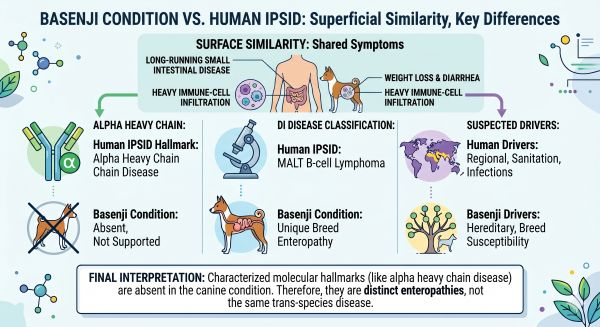
| Feature | Basenji enteropathy historically labeled IPSID | Human IPSID |
|---|---|---|
| Core clinical picture | Chronic diarrhea, progressive emaciation, maldigestion or malabsorption, protein loss, sometimes gastric involvement | Chronic diarrhea, steatorrhea, weight loss, malabsorption, abdominal pain, malnutrition |
| Main pathology | Lymphoplasmacytic infiltration of small intestine and sometimes stomach, with villus and mucosal injury | Proximal small bowel lymphoplasmacytic infiltrate progressing along a B cell lymphomatous spectrum with villous blunting |
| Immunoglobulin signal | Hypergammaglobulinemia and elevated serum IgA reported in affected dogs | Truncated alpha heavy chain is the classic hallmark, often without associated light chain |
| Alpha heavy chain disease | Not supported in the key Basenji study | Central historical and diagnostic feature of classic disease |
| Disease class | Breed associated chronic enteropathy with historical comparison to IPSID | Extra nodal marginal zone B cell lymphoma of mucosa associated lymphoid tissue, historically linked with alpha heavy chain disease |
| Suspected driver | Breed susceptibility and probable heredity, with mechanism still unsettled | Chronic enteric infection and prolonged antigenic stimulation, especially Campylobacter jejuni in at least some cases |
| Geographic pattern | Described mainly as a Basenji breed problem in veterinary referral literature, not a mapped regional belt | Concentrated historically in the Mediterranean, Middle East, parts of Africa, and Asia |
| Environmental story | No single shared trigger established. Diet protein swapping did not clearly explain the syndrome | Strong link to sanitation, low resource conditions, recurrent infection, and antibiotic responsive early disease in some cases |
| Best interpretation | Partial clinicopathologic analogy to human IPSID | Distinct human disease entity or spectrum |
Do Other Breeds Imply One Ancient Canine Syndrome?
No. Other breed enteropathies point in different mechanistic directions. These comparators weaken any simple story that ancient or early branching dogs share one ancestral enteropathy corresponding to human IPSID. The canine evidence instead supports multiple breed-specific routes to chronic intestinal disease.
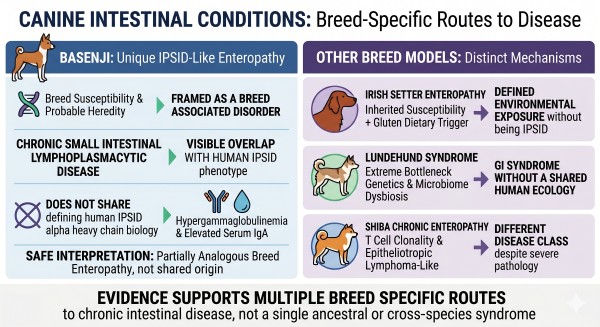
| Breed or model | Main syndrome | Best human analogy | What it suggests |
|---|---|---|---|
| Basenji | Chronic enteropathy with diarrhea, weight loss, malabsorption, protein loss, and lymphoplasmacytic intestinal disease | Only partial overlap with human IPSID, with similar gross pattern but no proof of alpha heavy chain disease | Best read as a distinct breed enteropathy that was historically labeled by analogy to human IPSID |
| Norwegian Lundehund | Protein losing gastroenteropathy with strong dysbiosis signal | Not especially IPSID like | Shows how a closed breed can develop a gut syndrome mainly through host genetic background |
| Irish Setter | Gluten sensitive enteropathy with villus injury | Closer to celiac type logic than to IPSID | Shows that canine enteropathy can be both genetic and exposure driven without implying cross species identity |
| Shiba | Severe chronic enteropathy with frequent clonality and poor prognosis | Closer to human intestinal T cell lymphoma than to IPSID | Shows that infiltrative breed enteropathy can tip toward lymphoma, but along a different lineage from human IPSID |
| Human IPSID reference | Small intestinal MALT type B cell lymphoma spectrum with alpha heavy chain disease and infectious links | The reference condition itself | This is a tighter human disease entity than the canine use of the term suggests |
The Bottom Line
The Basenji condition looks more like a partially analogous breed enteropathy than a demonstrated canine instance of the same disease. The better model is convergent resemblance plus different underlying causes.
References & Further Reading
Comparative IPSID & Breed Enteropathy
- Alyamany, R., Kharfan-Dabaja, M., Hamadani, M., Alshaibani, A., & Aljurf, M. (2022). The Evolution of Our Understanding of Immunoproliferative Small Intestinal Disease (IPSID) over Time. Current Oncology, 29, 3759–3769. https://doi.org/10.3390/curroncol29050301
- Batt, R. M., Carter, M. W., & McLean, L. (1984). Morphological and biochemical studies of a naturally occurring enteropathy in the Irish setter dog: a comparison with coeliac disease in man. Research in Veterinary Science, 37 3, 339–346. https://doi.org/10.1016/S0034-5288(18)31875-7
- Berghoff, N., Ruaux, C., Steiner, J., & Williams, D. A. (2007). Gastroenteropathy in Norwegian Lundehunds. Compendium, 29 8, 456–465, 468-70; quiz 470-1.
- Breitschwerdt, E. (1992). Immunoproliferative enteropathy of basenjis. Seminars in Veterinary Medicine and Surgery, 7 2, 153–161. https://doi.org/10.1002/9781119376293.ch68
- Breitschwerdt, E. B., Barta, O., Waltman, C., Hubbert, N. L., Pourciau, S. S., & Liu, W. (1983). Serum proteins in healthy Basenjis and Basenjis with chronic diarrhea. American Journal of Veterinary Research, 44 2, 326–328. https://doi.org/10.2460/ajvr.1983.44.02.326
- Breitschwerdt, E. B., Da, H., Sa, H., Tm, G., & Babineau, C. A. (1992). Effects of dietary protein source on Basenjis with immunoproliferative enteropathy. American Journal of Veterinary Research, 53 2, 234–236. https://doi.org/10.2460/ajvr.1992.53.02.234
- Breitschwerdt, E. B., Ochoa, R., Barta, M., Barta, O., McClure, J., & Waltman, C. (1984). Clinical and laboratory characterization of Basenjis with immunoproliferative small intestinal disease. American Journal of Veterinary Research, 45 2, 267–273. https://doi.org/10.2460/ajvr.1984.45.02.267
- Breitschwerdt, E. B., Waltman, C., Hagstad, H., Ochoa, R., McClure, J., & Barta, O. (1982). Clinical and epidemiologic characterization of a diarrheal syndrome in Basenji dogs. Journal of the American Veterinary Medical Association, 180 8, 914–920. https://doi.org/10.2460/javma.1982.180.08.914
- Breitschwerdt, E., Halliwell, W., Foley, C., Stark, D. R., & Corwin, L. A. (1980). A hereditary diarrhetic syndrome in the Basenji characterized by malabsorption, protein losing enteropathy and hypergammaglobulinemia. In Journal of The American Animal Hospital Association (Vol. 16, pp. 551–560).
- Buysscher, E. D. de, Breitschwerdt, E., & MacLachlan, N. J. (1988). Elevated serum IgA associated with immunoproliferative enteropathy of Basenji dogs: lack of evidence for alpha heavy-chain disease or enhanced intestinal IgA secretion. Veterinary Immunology and Immunopathology, 20 1, 41–52. https://doi.org/10.1016/0165-2427(88)90024-4
- Fine, K. D., & Stone, M. (1999). α-heavy chain disease, Mediterranean lymphoma, and immunoproliferative small intestinal disease. American Journal of Gastroenterology, 94, 1139–1152. https://doi.org/10.1111/j.1572-0241.1999.01057.x
- FlesjÅ, K., & Yri, T. (1977). Protein-losing enteropathy in the Lundehund. The Journal of Small Animal Practice, 18 1, 11–23. https://doi.org/10.1111/J.1748-5827.1977.TB05819.X
- Garden, O. A., Pidduck, H., Lakhani, K. H., Walker, D., Wood, J. L. N., & Batt, R. M. (2000). Inheritance of gluten-sensitive enteropathy in Irish Setters. American Journal of Veterinary Research, 61 4, 462–468. https://doi.org/10.2460/AJVR.2000.61.462
- Hall, E. J., & Batt, R. M. (1991). Abnormal permeability precedes the development of a gluten sensitive enteropathy in Irish setter dogs. Gut, 32, 749–753. https://doi.org/10.1136/gut.32.7.749
- Khojasteh, A., & Haghighi, P. (1990). Immunoproliferative small intestinal disease: portrait of a potentially preventable cancer from the Third World. The American Journal of Medicine, 89 4, 483–490. https://doi.org/10.1016/0002-9343(90)90380-V
- Khojasteh, A., Haghshenass, M., & Haghighi, P. (1983). Current concepts immunoproliferative small intestinal disease. A “Third-World lesion.” The New England Journal of Medicine, 308 23, 1401–1405.
- Kruiningen, H. (1977). Giant Hypertrophic Gastritis of Basenji Dogs. In Veterinary Pathology (Vol. 14, pp. 19–28). https://doi.org/10.1177/030098587701400103
- MacLachlan, N. J., Breitschwerdt, E., Chambers, J., Argenzio, R., & Buysscher, E. V. (1988). Gastroenteritis of Basenji Dogs. Veterinary Pathology, 25, 36–41. https://doi.org/10.1177/030098588802500105
- Melis, C., Billing, A., Wold, P.-A., & Ludington, W. (2023). Gut microbiome dysbiosis is associated with host genetics in the Norwegian Lundehund. Frontiers in Microbiology, 14. https://doi.org/10.3389/fmicb.2023.1209158
- Mesnard, B., Vroey, B. D., Maunoury, V., & Lecuit, M. (2004). Immunoproliferative small intestinal disease associated with Campylobacter jejuni. The New England Journal of Medicine, 350 3, 239–248. https://doi.org/10.1056/nejm200404153501619
- Metzger, J., Pfahler, S., & Distl, O. (2016). Variant detection and runs of homozygosity in next generation sequencing data elucidate the genetic background of Lundehund syndrome. BMC Genomics, 17. https://doi.org/10.1186/s12864-016-2844-6
- Ochoa, R., Eb, B., & Kl, L. (1984). Immunoproliferative small intestinal disease in Basenji dogs: morphologic observations. American Journal of Veterinary Research, 45 3, 482–490. https://doi.org/10.2460/ajvr.1984.45.03.482
- Ohmi, A., Ohno, K., Uchida, K., Goto-Koshino, Y., Tomiyasu, H., Kanemoto, H., Fukushima, K., & Tsujimoto, H. (2017). Significance of clonal rearrangements of lymphocyte antigen receptor genes on the prognosis of chronic enteropathy in 22 Shiba dogs. The Journal of Veterinary Medical Science, 79, 1578–1584. https://doi.org/10.1292/jvms.16-0626
- Ohmi, A., Ohno, K., Uchida, K., Nakayama, H., Koshino-Goto, Y., Fukushima, K., Takahashi, M., Nakashima, K., Fujino, Y., & Tsujimoto, H. (2011). A retrospective study in 21 Shiba dogs with chronic enteropathy. The Journal of Veterinary Medical Science, 73 1, 1–5. https://doi.org/10.1292/JVMS.10-0154
- Rambaud, J., Halphen, M., Galian, A., & Tsapis, A. (2004). Immunoproliferative small intestinal disease (IPSID): Relationships with α-chain disease and “Mediterranean” lymphomas. Springer Seminars in Immunopathology, 12, 239–250. https://doi.org/10.1007/BF00197509
- Salem, P., & Estephan, F. (2005). Immunoproliferative small intestinal disease: current concepts. Cancer Journal, 11 5, 374–382. https://doi.org/10.1097/00130404-200509000-00003