
Correlation ≠ Causation
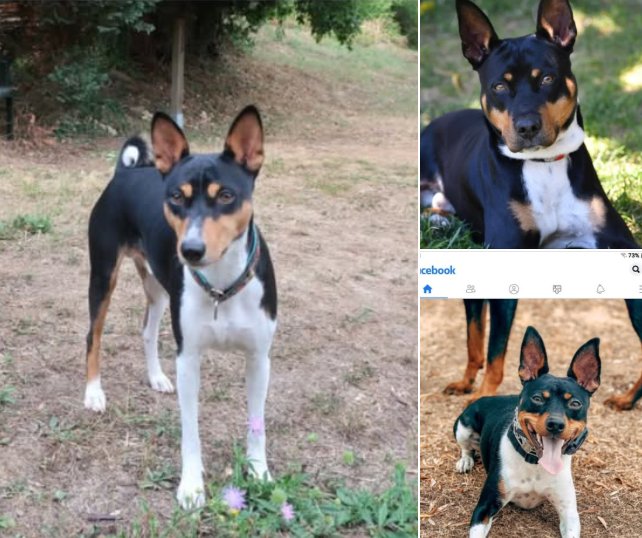
A Basenji and a Rat Terrier can look strikingly alike at a glance. The ears, the light frame, the narrow waist, the alert carriage, and the efficient stance all invite the eye to group them together. But in dogs, resemblance is not relatedness. Similar forms arise repeatedly when selection pulls different lineages toward the same working solution. What looks like kinship is often convergence (Parker et al., 2017).
That is the first point the genetics helps clean up. In the strongest breed-development paper in this project, (Parker et al., 2017), Rat Terrier does not sit near a Basenji-derived lineage. It appears in an American terrier history tied to feists, while Basenji sits in one of the most isolated parts of the breed network. The visual similarity is real, but the genealogical inference is not. The two should not be confused. Folklore has it that Milton Decker's Rat Terriers had Basenji genes bred into their lineage, and there are owner reports of basenji traits (less or no bark vocalizations, higher prey drive, less social referencing i.e. independence and lower recall versus non-Decker rat terriers), but neither websites I researched mentioned deliberate basenji incorporation. Rat Terrier Club of America, however, has Basenji displayed on its 2022 version Family Tree. This website's member photos show the diversity of Decker rat terriers with feature similarities to basenjis.
Looking Old ≠ Actually Basal
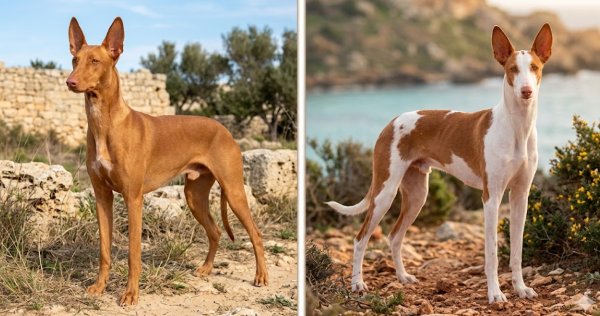
Parker's research team reinforces the same warning from another direction: Breeds that look ancient are not always genetically ancient. Pharaoh Hound and Ibizan Hound, despite their antique visual type, are treated there as likely recent recreations from other stock. Silhouette pattern-matching is a human cognitive shortcut, not a substitute for phylogeny. What makes Basenji especially interesting is not just that it is divergent, but that it appears unusually untouched by the usual kennel-era mixing machinery. Basenjis lack the prominent sharing signals that mark recurrent exchange elsewhere: it behaves less like a breed that was widely mined for transferable traits and more like a lineage left at the edge of the modern pedigree network (Parker et al., 2017).
Edwards et al. (2020) treats Basenji’s basal position as one reason it is useful as a reference genome. From Dollman (1937) the basenji was already visible to the pedigree world by the 1930s. Yet current evidence does not show basenjis acting as a recurrent donor breed in later formal breed formation (Dollman, 1937; Parker et al., 2004; Parker et al., 2017). The strongest defensible claim is therefore narrow but important: Basenji is notable not only for divergence, but for non-integration into the usual story of modern breed remixing.
The Lundehund Cautionary Tale
This folds into concepts about "breed integrity", which usually addresses 3 different aspects:
- 1. a scientific layer about disease risk and managed diversity,
- 2. an institutional component about "who" gets to define the breed ("standard"), and
- 3. a symbolic aspect about "purity, prestige, and aesthetic loyalty".
Scientific concerns deal with uncontrolled outcrossing (making "designer" basenji hybrids) that can disrupt disease management and make inference harder. However, the institutional and symbolic aspects around the basenji "breed integrity" and "breed standard conformations" appear opaque and even tribal.
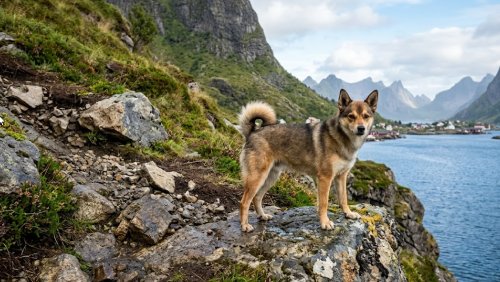
The Norwegian Lundehund is an extreme intersection of these 3 aspects. In Stronen et al. (2017), the breed is described as passing through repeated twentieth-century bottlenecks in which only five inbred dogs remained after each crash, with the living population apparently descending from only two individuals. Expected heterozygosity was reported at 0.035, far below the comparison breeds used in the rescue program. Kettunen et al. (2017) goes further to estimating the effective population size at roughly 13. They concluded that breeding optimization inside the closed population offered no meaningful remedy. Their blunt and brutal conclusion: the only viable conservation option is by introducing foreign breeding candidates.
Survival of... the Most Adaptable?
The microbiome evidence sharpens the point. Melis et al. (2023) found that host genetic background was associated with gut microbiome composition; purebred Lundehunds showed a dysbiosis-linked profile that differed markedly from outcross progeny. A breeding program can screen known loci, pedigrees, and some disease risks while remaining partly blind to higher-order host-microbiome interactions that also shape health. Conservation is therefore always partly epistemic: it preserves what can be measured while risking what cannot yet be seen.
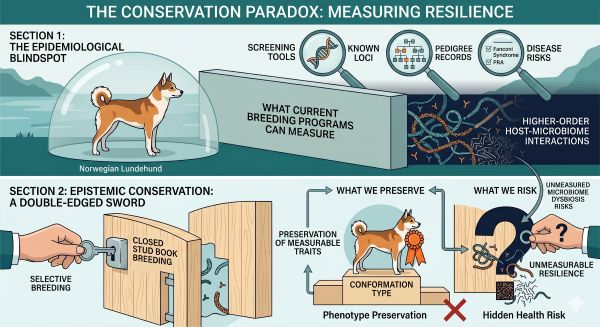
This is where preservation of breed purity collides with population genetics. A breed can remain visually recognizable while losing the variation needed for long-run viability. Closed breeding can simultaneously preserve type and destroy resilience. What is being conserved, at that point, is not adaptive capacity but the outward continuity of a preferred form. "Survival of the fittest" is not an applicable evolutionary frame here, but whether a population "remain adaptable under change". Fitness is always local and conditional. Long-run resilience depends less on perfect optimization for one constant environment than on preserving options for unpredictable futures.
Preserving Adaptable, "Pure" Basenji Breeds
The Basenji case becomes more than a point about one unusual breed. It becomes a clean instance of the central contradiction in conservation genetics. The more tightly a breed is defined and selected toward one fixed identity, the more pressure is placed on the very diversity that makes future adaptation possible. Basenji makes this contradiction unusually visible because the breed’s ancestral source populations still exist in the broader African dog landscape, even though they are themselves products of long human history rather than a pristine natural baseline (Bergström et al., 2020; Bergström et al., 2022; Boyko et al., 2009; Freedman et al., 2014; Shannon et al., 2015).
In the United States, the Basenji Club of America (BCOA) African Stock Project serves as a proactive intervention against the "conservation paradox" by deliberately reopening the studbook to integrate new genetic material. Its primary goal is to increase genomic heterogeneity within the Western population, which was originally built from a dangerously narrow founder pool of fewer than 30 dogs. By introducing foundation stock directly from the Congo basin, the project aims to curb the "popular sire" effect and restore the long-run resilience that is often eroded by generations of closed-loop breeding. This effort ensures that the Basenji remains a "living" lineage—preserving not just its iconic "ancient" silhouette, but the adaptive capacity and healthy vitality required to survive future environmental and biological shifts.
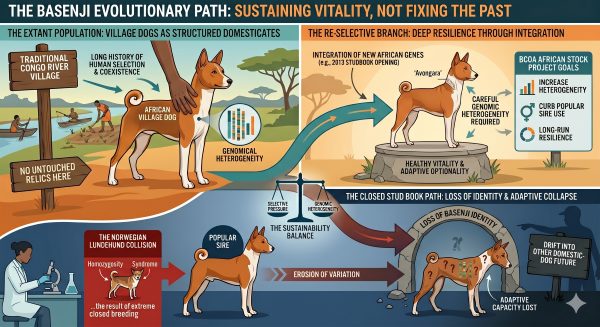
There is no simple return to nature for basenjis: African village dogs are not untouched relics but structured domestic populations shaped over long periods of human selection and coexistence (Boyko et al., 2009; Shannon et al., 2015). Ancient-genome work further shows that dogs had already diversified deeply by about 11,000 years. No sampled living wolf population serves as a clean proxy for the original progenitor (Bergström et al., 2020; Bergström et al., 2022; Freedman et al., 2014). Without continued selection, a Basenji population would not remain Basenji in any fixed modern sense. It would drift into some other domestic-dog future. But careful genomic heterogeneity is required to sustain the healthy vitality of this unique dog.
References
- Bergström, A., Frantz, L., Schmidt, R. W., Ersmark, E., Lebrasseur, O., Girdland-Flink, L., Lin, A. T., Storå, J., Sjögren, K., Anthony, D., Antipina, E. E., Amiri, S., Bar-Oz, G., Bazaliiskii, V. I., Bulatović, J., Brown, D., Carmagnini, A., Davy, T., Fedorov, S., … Skoglund, P. (2020). Origins and genetic legacy of prehistoric dogs. Science, 370, 557–564. https://doi.org/10.1126/science.aba9572
- Bergström, A., Stanton, D., Taron, U. H., Frantz, L., Sinding, M.-H. S., Ersmark, E., Pfrengle, S., Cassatt-Johnstone, M., Lebrasseur, O., Girdland-Flink, L., Fernandes, D., Ollivier, M., Speidel, L., Gopalakrishnan, S., Westbury, M., Ramos-Madrigal, J., Feuerborn, T., Reiter, E., Gretzinger, J., … Skoglund, P. (2022). Grey wolf genomic history reveals a dual ancestry of dogs. Nature, 607, 313–320. https://doi.org/10.1038/s41586-022-04824-9
- Boyko, A., Boyko, R. H., Boyko, C. M., Parker, H., Castelhano, M., Corey, L., Degenhardt, J. D., Auton, A., Hedimbi, M., Kityo, R., Ostrander, E., Schoenebeck, J., Todhunter, R., Jones, P., & Bustamante, C. (2009). Complex population structure in African village dogs and its implications for inferring dog domestication history. Proceedings of the National Academy of Sciences, 106, 13903–13908. https://doi.org/10.1073/pnas.0902129106
- Dollman, G. (1937). THE BASENJI DOG. In African Affairs (pp. 148–149). https://doi.org/10.1093/OXFORDJOURNALS.AFRAF.A101424
- Edwards, R. J., Field, M., Field, M., Ferguson, J. M., Dudchenko, O., Dudchenko, O., Keilwagen, J., Rosen, B., Gs, J., Rice, E., Hillier, L., Hammond, J., Towarnicki, S. G., Omer, A. D., Omer, A. D., Khan, R., Khan, R., Skvortsova, K., Skvortsova, K., … Jwo, B. (2020). Chromosome-length genome assembly and structural variations of the primal Basenji dog (Canis lupus familiaris) genome. BMC Genomics, 22. https://doi.org/10.1186/s12864-021-07493-6
- Freedman, A., Gronau, I., Schweizer, R., Vecchyo, D. O.-D., Han, E., Silva, P., Galaverni, M., Fan, Z., Marx, P., Lorente-Galdos, B., Beale, H. C., Ramírez, O., Hormozdiari, F., Alkan, C., Vilà, C., Squire, K., Geffen, E., Kusak, J., Boyko, A., … Novembre, J. (2014). Genome Sequencing Highlights the Dynamic Early History of Dogs. PLoS Genetics, 10. https://doi.org/10.1371/journal.pgen.1004016
- Kettunen, A., Daverdin, M., Helfjord, T., & Berg, P. (2017). Cross-Breeding Is Inevitable to Conserve the Highly Inbred Population of Puffin Hunter: The Norwegian Lundehund. PLoS ONE, 12. https://doi.org/10.1371/journal.pone.0170039
- Melis, C., Billing, A., Wold, P.-A., & Ludington, W. (2023). Gut microbiome dysbiosis is associated with host genetics in the Norwegian Lundehund. Frontiers in Microbiology, 14. https://doi.org/10.3389/fmicb.2023.1209158
- Parker, H., Dreger, D., Rimbault, M., Davis, B., Mullen, A. B., Carpintero-Ramirez, G., & Ostrander, E. (2017). Genomic Analyses Reveal the Influence of Geographic Origin, Migration, and Hybridization on Modern Dog Breed Development. Cell Reports, 19 4, 697–708. https://doi.org/10.1016/j.celrep.2017.03.079
- Parker, H., Kim, L., Sutter, N., Carlson, S., Lorentzen, T. D., Malek, T. B., Johnson, G., DeFrance, H. B., Ostrander, E., & Kruglyak, L. (2004). Genetic Structure of the Purebred Domestic Dog. Science, 304, 1160–1164. https://doi.org/10.1126/SCIENCE.1097406
- Shannon, L. M., Boyko, R. H., Castelhano, M., Corey, E., Hayward, J. J., McLean, C., White, M. E., Said, M. R. A., Anita, B. A., Bondjengo, N., Calero, J., Galov, A., Hedimbi, M., Imam, B., Khalap, R., Lally, D. T., Masta, A., Oliveira, K. C., Pérez, L., … Boyko, A. (2015). Genetic structure in village dogs reveals a Central Asian domestication origin. Proceedings of the National Academy of Sciences, 112, 13639–13644. https://doi.org/10.1073/pnas.1516215112
- Stronen, A. V., Salmela, E., Baldursdottir, B., Berg, P., Espelien, I., Järvi, K., Jensen, H., Kristensen, T., Melis, C., Manenti, T., Lohi, H., & Pertoldi, C. (2017). Genetic rescue of an endangered domestic animal through outcrossing with closely related breeds: A case study of the Norwegian Lundehund. PLoS ONE, 12. https://doi.org/10.1371/journal.pone.0177429