
Basenjis as cat-like dogs from an early branch of dog history
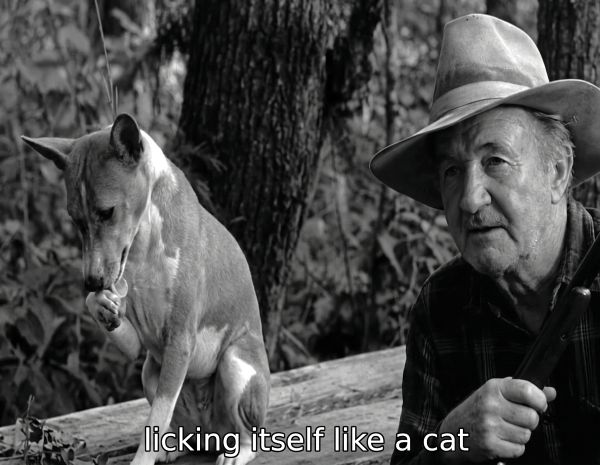
The most accurate current description of the Basenji is a genetically divergent, early-branching modern African dog-lineage within the ordinary domestic dog radiation, formed in Africa from older dog ancestry that likely entered the continent with humans from Eurasia. Basenjis are notable for a more independent and less human-referencing social style than highly cooperative modern working breeds, predominantly annual estrus, and an unusual vocal profile often described as barkless [Ballard 2021] [Bergstrom 2020] [Boyko 2009] [Edwards 2021] [Freedman 2014] [Freedman 2017] [Gardner 2025] [Parker 2017] [Shannon 2015].
The short answer to where Basenjis came from
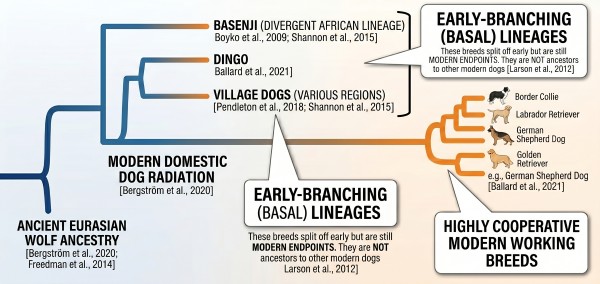
If the question is where Basenjis’ ancestors actually came from, the best answer has two layers. Deep dog ancestry did not originate in Africa. The strongest modern synthesis is that dogs as a whole arose from ancient wolf ancestry in Eurasia, from a source population not represented by any living wolf population sampled today [Bergstrom 2020] [Bergstrom 2022] [Freedman 2014] [Freedman 2017]. By about 11,000 years ago, ancient DNA supports at least five major dog lineages already being distinct, which means the deep structure of dog history predates every modern breed by a very long margin [Bergstrom 2020].
Basenjis, however, are not "Eurasian dogs accidentally left in Africa." The safer reading is that earlier domesticated dogs entered Africa with people, and that the Basenji lineage formed later within African dog populations, especially within a broader sub-Saharan background rather than as a separate domestication event [Bergstrom 2020] [Boyko 2009] [Shannon 2015]. In that sense, Basenji origin is African at the breed-lineage level and Eurasian at the deepest domestication level.
What "basal clade" does, and does not mean
The term "basal clade" should be handled carefully. In this literature, "basal" means early-branching within a tree of sampled living dogs or unusually divergent among modern breeds. It does not mean ancestor of the other breeds, direct copy of the first dogs, or separate root outside the main domestic dog radiation [Bergstrom 2020] [Freedman 2017] [Parker 2017].
That distinction matters because tree position is easy to overread. A breed can split off relatively early in a modern breed tree and still be a modern endpoint rather than the source from which the others descended. Larson and colleagues made the criticism more sharply than the usual "not a perfect relic" summary suggests. Their point was not merely that so-called ancient breeds preserve the original dog condition imperfectly. It was that some may appear ancient mainly because recent isolation, founder effects, and breed bottlenecks made them genetically distinctive, which means modern breed distinctness may tell us little or nothing reliable about the first dogs [Larson 2012]. Ancient DNA sharpened the same caution by showing that the real early dog branches were already diversified long before modern breeds existed [Bergstrom 2020].
Why "primitive" is common-speech but not scientific
"Primitive" survives in ordinary breed talk because it sums a real cluster of impressions: old lineage, unusual behavior, seasonal reproduction, less reshaping by recent European breed fashion, and a look or demeanor that feels less overworked by modern kennel culture. But "primitive" as a scientific term mixes ancestry, behavior, appearance, and value judgment into one word [Freedman 2017] [Larson 2012].
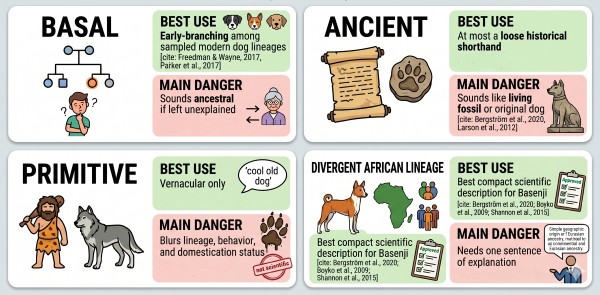
| Term | Best use | Main danger |
|---|---|---|
| Basal | Early-branching among sampled modern dog lineages [Freedman 2017] [Parker 2017] | Mistaken for ancestral or source lineage |
| Ancient | At most a loose historical shorthand | Mistaken for living fossil, original dog, or unchanged relic |
| Primitive | Vernacular only | Blurs lineage, behavior, and domestication status |
| Divergent African lineage | Best compact scientific description for Basenji [Bergstrom 2020] [Boyko 2009] [Shannon 2015] | Needs one sentence of explanation |
Why the cat-like heuristic works at all
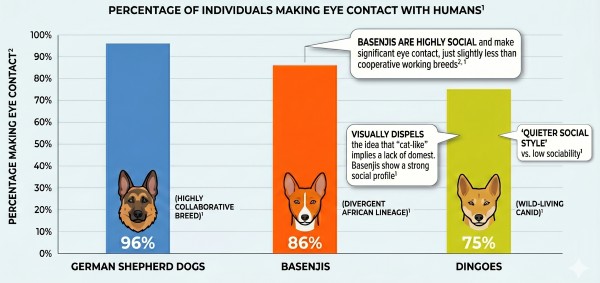
The cat-like description works because it points to a social style, not a species identity. Across behavior studies, early-branching or ancient-group dogs tend to show less attachment and attention-seeking, less spontaneous human-directed gaze, and less default recruitment of humans in problem tasks than herding, retriever, or other strongly cooperative modern breeds [Konno 2016] [Poucke 2021] [Tonoike 2015].
Within this study’s cohort, 86 percent of Basenjis made eye contact, compared with 96 percent of German Shepherd Dogs and 75 percent of dingoes [Ballard 2021]. Basenjis increased gaze when actively called and spent substantial time near people, especially familiar people. In fact, in that study they spent more total time within one meter of the human than the German Shepherds did, and far more than the dingoes [Ballard 2021]. That is not the profile of a detached or weakly domesticated animal. It is the profile of a dog that is social, but less theatrically approval-seeking than breeds selected for strong human-guided cooperation.
The distinctive traits that make the breed feel old
Some Basenji traits do reinforce the sense that the breed sits a bit apart from the average modern pet dog. The behavior literature supports lower human-directed social referencing than highly collaborative breeds [Ballard 2021] [Konno 2016] [Poucke 2021]. The reproductive literature supports genuine seasonality. In a 2025 Australian pedigree analysis of 5,796 Basenjis and 1,332 litters, the main breeding season was May through July, with 12.5 percent of litters born outside that window [Gardner 2025].
The vocal reputation belongs in the same category of real trait, overstated folklore. Basenjis are widely known as barkless dogs, and that label is old and sticky enough to have become part of the breed’s public identity [Edwards 2021]. But the more accurate implication is unusual vocal style, not literal muteness. Basenjis vocalize plenty; their larynx anatomy produces yodels, screams, and chortles rather than the staccato bark characteristic of most modern breeds [Edwards 2021]. In the broader behavior literature they appear less vocal than some other ancient-breed comparators, but the project does not support turning barklessness into a grand evolutionary theory [Edwards 2021] [Wojcik 2021].
Bottom line
The Basenji is a divergent African-lineage of domestic dog that branches relatively early in modern breed phylogenies, formed in Africa from deeper dog ancestry that likely reached the continent through human movement out of Eurasia, and carrying a cluster of distinctive traits that make the breed feel older and less socially overcommitted than many modern collaborative dogs. [Ballard 2021] [Bergstrom 2020] [Boyko 2009] [Edwards 2021] [Freedman 2017] [Gardner 2025] [Parker 2017] [Shannon 2015].
- ● They aren't "wild" or "wolves": They are fully domesticated dogs.
- ● They are an "early branch" of the family tree: Think of them as a cousin that moved away a long time ago, rather than the "grandmother" of all dogs.
- ● Their ancestors traveled: Their deep roots are actually in Eurasia, but the specific breed we know today developed and became unique while living in sub-Saharan Africa.
- ● They have a different social "vibe": Because they weren't bred for centuries to follow human commands (like a Retriever or a Shepherd), they are more independent.
- ● The "Cat-Like" label is about focus and self-grooming: They love their people, but they aren't "approval-seeking" in the way many modern breeds are. They tend to solve problems on their own rather than looking to a human for help. Much like a cat, the Basenji's social style is quieter and less driven by a default need for human recruitment or constant eye contact. The self-grooming contributes to the "primitive" or "ancient" feel of the breed: a look and demeanor that feels less shaped by the "overworked" kennel culture of modern European breeds.
- ● They have unique biological "quirks": This includes being "barkless" (meaning an unusual vocal style versus stereotypical domestic canine vocalizations, not indicating "soundless") and having a predominantly annual breeding season.
References
- Ballard, J., et al. (2021). Eye contact and sociability data suggests that Australian dingoes were never domesticated. Current Zoology, 68, 423–432. https://doi.org/10.1093/cz/zoab024
- Bergström, A., et al. (2020). Origins and genetic legacy of prehistoric dogs. Science, 370, 557–564. https://doi.org/10.1126/science.aba9572
- Bergström, A., et al. (2022). Grey wolf genomic history reveals a dual ancestry of dogs. Nature, 607, 313–320. https://doi.org/10.1038/s41586-022-04824-9
- Boyko, A., et al. (2009). Complex population structure in African village dogs and its implications for inferring dog domestication history. PNAS, 106, 13903–13908. https://doi.org/10.1073/pnas.0902129106
- Edwards, R. J., et al. (2021). Chromosome-length genome assembly and structural variations of the primal Basenji dog genome. BMC Genomics, 22. https://doi.org/10.1186/s12864-021-07493-6
- Freedman, A., et al. (2014). Genome Sequencing Highlights the Dynamic Early History of Dogs. PLoS Genetics, 10. https://doi.org/10.1371/journal.pgen.1004016
- Freedman, A., & Wayne, R. (2017). Deciphering the Origin of Dogs: From Fossils to Genomes. Annual Review of Animal Biosciences, 5, 281–307. https://doi.org/10.1146/annurev-animal-022114-110937
- Gardner, C., et al. (2025). Non-seasonal breeding appears dominant with incomplete penetrance in Australian Basenji dogs. Scientific Reports, 15. https://doi.org/10.1038/s41598-025-27059-w
- Konno, A., et al. (2016). Dog Breed Differences in Visual Communication with Humans. PLoS ONE, 11. https://doi.org/10.1371/journal.pone.0164760
- Larson, G., et al. (2012). Rethinking dog domestication by integrating genetics, archeology, and biogeography. PNAS, 109, 8878–8883. https://doi.org/10.1073/pnas.1203005109
- Parker, H., et al. (2017). Genomic Analyses Reveal the Influence of Geographic Origin, Migration, and Hybridization on Modern Dog Breed Development. Cell Reports, 19 4, 697–708. https://doi.org/10.1016/j.celrep.2017.03.079
- Pendleton, A. L., et al. (2018). Comparison of village dog and wolf genomes highlights the role of the neural crest in dog domestication. BMC Biology, 16. https://doi.org/10.1186/s12915-018-0535-2
- Poucke, E. V., et al. (2021). Breed group differences in the unsolvable problem task. Animal Cognition, 25, 597–603. https://doi.org/10.1007/s10071-021-01582-5
- Shannon, L. M., et al. (2015). Genetic structure in village dogs reveals a Central Asian domestication origin. PNAS, 112, 13639–13644. https://doi.org/10.1073/pnas.1516215112
- Surbakti, S., et al. (2020). New Guinea highland wild dogs are the original New Guinea singing dogs. PNAS, 117, 24369–24376. https://doi.org/10.1073/pnas.2007242117
- Tonoike, A., et al. (2015). Comparison of owner-reported behavioral characteristics among genetically clustered breeds of dog. Scientific Reports, 5. https://doi.org/10.1038/srep17710
- Vonholdt, B., et al. (2010). Genome-wide SNP and haplotype analyses reveal a rich history underlying dog domestication. Nature, 464, 898–902. https://doi.org/10.1038/nature08837
- Wójcik, A., & Powierża, K. (2021). The Influence of Breed, Sex, Origin and Housing Conditions on Undesirable Behaviors in Ancient Dog Breeds. Animals, 11. https://doi.org/10.3390/ani11051435