
Owners and vets sometimes encounter a seeming contradiction in Basenjis: the breed has a reputation for intense prey drive and fast emotional engagement, yet also carries a well-documented chronic enteropathy syndrome. If basenjis are so wired for pursuit and arousal, how can they also have famously fragile guts? The question assumes that behavioral intensity and gut robustness travel together. The literature does not support that assumption.
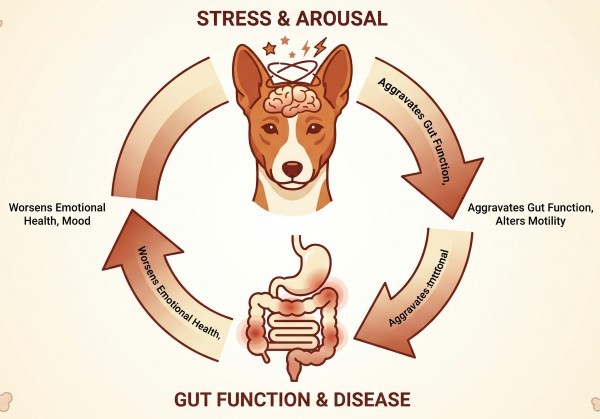
The best-supported model from the current evidence is not a self-contradictory breed. Basenjis are dogs with strong chase and engagement systems AND a vulnerable gut. In basenjis, repeated arousal MAY worsen gut function, and gut disease MAY in turn worsen emotional strain. The evidence for this two-way loop is solid at the general canine level and only indirect at the Basenji-specific level.
What the Evidence Actually Shows
Not every claim about Basenjis and stress carries the same evidentiary weight. The table below separates what is directly shown from what is inferred or unsupported.
| Claim | Status | Best support |
|---|---|---|
| Basenjis have a published breed-linked chronic enteropathy syndrome | Directly shown | Breitschwerdt et al. (1980, 1984); Ochoa et al. (1984) |
| Stress and arousal can change GI function in dogs | Directly shown in experimental dog studies | Buéno & Fioramonti (1986); Gué et al. (1987, 1989); Lei & Chen (2009); Pappas et al. (1985) |
| Chronic enteropathy can affect emotional health and owner-reported behavior | Directly shown in recent canine clinical work | Ludvigsson et al. (2026); Marchetti et al. (2021) |
| Mild stress-sensitive or functional GI patterns exist in some dogs | Moderately supported | Cerquetella et al. (2018); Kaufmann et al. (2025); Leib (2000); Marion (2017) |
| Arousal management may help some GI-prone dogs as an adjunct | Reasonable inference, not Basenji-specific proof | Albright & Haug (2026); Jergens & Heilmann (2022); Marion (2017); Tooley & Heath (2023) |
| Prey drive specifically causes Basenji enteropathy | Not shown | No retrieved paper demonstrates this |
| Basenjis are uniquely stress-reactive compared with other dogs | Not shown | No retrieved paper demonstrates this |
The Basenji Gut Problem Is Real
The direct Basenji GI literature is stronger than the direct Basenji stress literature. Across the key breed papers, affected Basenjis repeatedly showed chronic or intractable diarrhea, progressive emaciation or failure to hold condition, malabsorption or maldigestion, low protein states, and lymphoplasmacytic inflammation of the small intestine, with gastric involvement in some dogs. One older feeding trial also matters because it weakens the simplest food-trigger story: changing among ordinary poultry, cereal, and red meat protein sources did not materially change the main disease measures in affected Basenjis. This shows that the Basenji gut problem is not well explained as ordinary excitability plus an occasional nervous stomach. There is a true disease signal in the breed literature.
The direct Basenji behavior literature is much thinner. In controlled work, Basenjis were clearly social with humans but showed less intense human-directed gaze than German Shepherd Dogs. In broader ancient-breed survey work, dog and animal aggression plus undesirable motor behavior were recurrent owner concerns in the group that included Basenjis. An older puppy experiment suggested that Basenjis inhibited agonistic carryover more slowly than Shetland Sheepdogs after differential handling. These papers support a picture of a dog that may be fast to engage, self-directed, and not always quick to settle after arousal — but they do not prove that Basenjis are uniquely stress-sensitive in a medical sense, and they do not prove that prey drive causes the breed enteropathy.
How Stress Changes Gut Function
The stress-gut literature in dogs is much stronger than the Basenji-specific link. Experimental work found that corticotropin-releasing factor (CRF) inhibited gastric emptying in dogs. Related dog studies showed that CRF, ACTH, cortisol, and acoustic stress altered gastrointestinal motility. In post-meal settings, stress changed gastric emptying, postprandial motility, and gut hormone patterns. Multiple forms of stress also inhibited gastric tone and gastric myoelectrical activity in dogs. Reviews centered on CRF signaling place these findings in a broader gut-brain model in which stress shifts motility, secretion, and barrier control.
The tight conclusion from this layer is simple: in dogs, arousal can change how the gut moves and functions even without causing primary inflammatory disease. Arousal is not the same thing as disease. Chasing, orienting, and fast activation are not diseases. The stronger claim in the literature is narrower — repeated or intense arousal can disrupt gut function through autonomic and neuroendocrine pathways.
The Gut Pushes Back on Behavior
The newer enteropathy papers are important because they reverse the direction of the question. The issue is not only whether stress worsens the gut. It is also whether chronic gut disease worsens emotional health. In Marchetti et al. (2021), dogs with chronic inflammatory enteropathy had significantly worse quality of life than healthy dogs, and symptomatic dogs showed more separation-related and attention-seeking behavior than they did after treatment. In Ludvigsson et al. (2026), dogs with chronic enteropathy, even with low disease activity, showed signs consistent with compromised emotional health compared with matched controls.
If a dog already has nausea, urgency, abdominal discomfort, poor sleep, or chronic inflammation, behavior may change in ways that owners read as clinginess, irritability, or volatility. In that sense, the gut can help create the high-strain dog that later seems to confirm the owner's original suspicion about temperament.
The Mechanistic Bridge
The mechanistic literature is stronger for general canine and comparative gut-brain biology than for Basenjis alone. Still, it offers a coherent bridge between arousal and GI symptoms across several layers.
| Mechanistic layer | What the literature supports | Most relevant papers |
|---|---|---|
| Gastric emptying and stomach function | Stress and CRF signaling can inhibit gastric emptying and alter gastric tone | Gué et al. (1989); Lei & Chen (2009); Pappas et al. (1985); Taché et al. (2001) |
| Intestinal and colonic motility | Acoustic and other stressors can disturb GI motor patterns | Buéno & Fioramonti (1986); Gué et al. (1987); Taché et al. (2018) |
| Barrier and permeability | Stress biology can increase epithelial permeability and weaken mucosal regulation in comparative models | Gareau et al. (2008); Rodiño-Janeiro et al. (2015); Santos et al. (1999, 2001); Saunders et al. (2004) |
| Immune and inflammatory tone | Chronic enteropathy reflects loss of tolerance to dietary and microbial inputs plus mucosal immune dysregulation | Heilmann et al. (2026); Jergens & Heilmann (2022) |
| Microbiome signaling | Dysbiosis and altered microbial metabolites are part of canine enteropathy and broader gut-brain signaling, though stress effects are not uniform | Albright & Haug (2026); Patel et al. (2024); Wang et al. (2019) |
| Brainward effects of gut disease | Chronic enteropathy is associated with poorer emotional health and more behavior change | Ludvigsson et al. (2026); Marchetti et al. (2021) |
The best synthesis: a Basenji may have a baseline tendency toward fast engagement and high activation in salient situations. If that dog also has a vulnerable gut, repeated autonomic arousal may worsen motility, emptying, urgency, or barrier instability. If true enteropathy is present, the inflamed gut may then worsen comfort, sleep, and emotional steadiness. The owner sees a dog who seems both over-aroused and stomach-fragile, even though the two traits need not share one root cause. That model is not proven specifically in Basenjis — it is the best evidence-based inference from the current search.
What Feeding Schedule Does and Does Not Do
The feeding-schedule evidence is much thinner than the stress-gut and enteropathy evidence. There is no proof that twice-daily feeding prevents chronic enteropathy, and no proof that free-feeding causes it. The strongest schedule-related signal is that one large daily meal is associated with gastric dilatation and GDV risk in susceptible dogs. For chronic enteropathy and protein-losing disease, the literature is primarily about what is fed rather than how often.
| If the main pattern is | Start by prioritizing | Why |
|---|---|---|
| Chronic diarrhea, weight loss, poor body condition | Vet workup and strict therapeutic diet trial | Strongest evidence is for enteropathy assessment and diet composition (Heilmann et al., 2026) |
| Bile vomiting, reflux-like signs, empty-stomach upset | Smaller scheduled meals and symptom tracking | More plausible fit with fasting interval and upper-GI physiology (Pappas et al., 1985; 2017 reflux paper) |
| Bloat concern or upper-GI distension risk | Avoid one large daily meal | Strongest schedule-related risk signal (Glickman et al., 1997; Raghavan et al., 2004) |
| Stress-linked flare pattern around meals or events | Calm routine plus medical workup | Stress can alter gut function but does not rule out real disease (Breitschwerdt et al., 1984; Gué et al., 1989) |
Practical Guidance for Owners
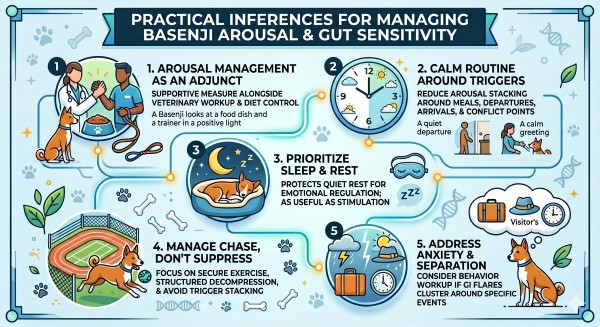
Medical warning signs that need a vet, not lifestyle management
Basenjis do have a documented enteropathy signal. Recurrent diarrhea, weight loss, failure to hold condition, vomiting, poor appetite, or edema should not be waved away as temperament or a fussy stomach. The strongest warning clusters are: diarrhea plus weight loss; vomiting plus weight loss; low energy with chronic GI signs; swelling of the belly or limbs; and recurring flares after short periods of improvement.
What the current enteropathy guideline supports
For clinically stable dogs with chronic GI signs, dietary treatment is the preferred first diagnostic step. The current ACVIM-endorsed consensus supports exclusive feeding of a therapeutic diet during the trial, at least two weeks per diet trial, consideration of at least three different diet categories before deciding the dog is not food-responsive, and keeping the successful diet in place for at least twelve weeks before broadening food again. Faster escalation is warranted when there is marked weight loss, hypoalbuminemia, edema, ascites, or high clinical severity.
Arousal management as adjunct, not substitute
If a Basenji has recurrent GI upset, reducing chronic over-arousal is a sensible support measure. It should sit beside veterinary workup and diet control — not replace them. Calm routine matters most around predictable trigger windows: meals, immediately after meals, departures, arrivals, and known conflict points. Poor sleep reduces a dog's ability to regulate total emotional load, so protecting quiet rest may be as useful as adding stimulation. The papers do not suggest a Basenji should be made low-drive. They suggest that repeated uncontrolled arousal may be costly in a vulnerable dog — pointing toward secure exercise, structured decompression, and avoiding repeated trigger stacking rather than trying to extinguish all predatory interest.
Tracking that actually helps
A useful owner log should include stool frequency and quality, vomiting episodes, appetite, weekly body weight when possible, body condition and muscle loss, sleep disruption, and major arousal events such as visitors, travel, separation, conflict, or intense chase episodes — alongside all treats, chews, scavenging, and medication flavorings. That kind of log helps separate a chronic medical pattern from one-off upset and may reveal whether flares cluster around stressors, dietary escapes, or both.
The Bottom Line
The current literature does not show that Basenjis have high prey drive because their guts are sensitive, or that prey drive specifically causes Basenji enteropathy. It supports a more useful picture: a breed with a real genetic enteropathy signal, a general canine stress-gut mechanism that can worsen that vulnerability, and a bidirectional gut-brain loop that means chronic gut disease can itself produce the unsettled, distressed-seeming dog an owner may already be attributing to temperament alone.
As Sachi's human, I'm learning to pay attention to chronic GI signs, changes in her temperament, and tracking Sachi's arousal and emotional load given Sachi's gut-sensitivity.
References & Further Reading
Basenji-Specific Gut Literature
- Breitschwerdt, E., Halliwell, W., Foley, C., Stark, D. R., & Corwin, L. A. (1980). A hereditary diarrhetic syndrome in the Basenji characterized by malabsorption, protein losing enteropathy and hypergammaglobulinemia. Journal of The American Animal Hospital Association, 16, 551–560.
- Breitschwerdt, E. B., Waltman, C., Hagstad, H., Ochoa, R., McClure, J., & Barta, O. (1982). Clinical and epidemiologic characterization of a diarrheal syndrome in Basenji dogs. Journal of the American Veterinary Medical Association, 180 8, 914–920. https://doi.org/10.2460/javma.1982.180.08.914
- Breitschwerdt, E. B., Ochoa, R., Barta, M., Barta, O., McClure, J., & Waltman, C. (1984). Clinical and laboratory characterization of Basenjis with immunoproliferative small intestinal disease. American Journal of Veterinary Research, 45 2, 267–273. https://doi.org/10.2460/ajvr.1984.45.02.267
- Breitschwerdt, E. (1992). Immunoproliferative enteropathy of basenjis. Seminars in Veterinary Medicine and Surgery, 7 2, 153–161. https://doi.org/10.1002/9781119376293.ch68
- Breitschwerdt, E. B., Da, H., Sa, H., Tm, G., & Babineau, C. A. (1992). Effects of dietary protein source on Basenjis with immunoproliferative enteropathy. American Journal of Veterinary Research, 53 2, 234–236. https://doi.org/10.2460/ajvr.1992.53.02.234
- Breitschwerdt, E., MacLachlan, N. J., Argenzio, R., Hurlbert, S., Babineau, C., & Buysscher, E. D. de. (1991). Gastric acid secretion in Basenji dogs with immunoproliferative enteropathy. Journal of Veterinary Internal Medicine, 5 1, 34–39. https://doi.org/10.1111/J.1939-1676.1991.TB00928.X
- Ochoa, R., Eb, B., & Kl, L. (1984). Immunoproliferative small intestinal disease in Basenji dogs: morphologic observations. American Journal of Veterinary Research, 45 3, 482–490. https://doi.org/10.2460/ajvr.1984.45.03.482
Basenji Behavior and Ancient-Breed Studies
- Ballard, J., Gardner, C., Ellem, L., Yadav, S., & Kemp, R. (2021). Eye contact and sociability data suggests that Australian dingoes were never domesticated. Current Zoology, 68, 423–432. https://doi.org/10.1093/cz/zoab024
- Scott, J. P., Bronson, F., & Trattner, A. (1968). Differential human handling and the development of agonistic behavior in basenji and shetland sheep dogs. Developmental Psychobiology, 1, 133–140. https://doi.org/10.1002/DEV.420010211
- Wójcik, A., & Powierża, K. (2021). The influence of breed, sex, origin and housing conditions on undesirable behaviors in ancient dog breeds. Animals, 11. https://doi.org/10.3390/ani11051435
Stress, Arousal, and Gut Function in Dogs
- Buéno, L., & Fioramonti, J. (1986). Effects of corticotropin-releasing factor, corticotropin and cortisol on gastrointestinal motility in dogs. Peptides, 7 1, 73–77. https://doi.org/10.1016/0196-9781(86)90064-1
- Gué, M., Fioramonti, J., Frexinos, J., Alvinerie, M., & Buéno, L. (1987). Influence of acoustic stress by noise on gastrointestinal motility in dogs. Digestive Diseases and Sciences, 32, 1411–1417. https://doi.org/10.1007/BF01296668
- Gué, M., Peeters, T., Depoortere, I., Vantrappen, G., & Buéno, L. (1989). Stress-induced changes in gastric emptying, postprandial motility, and plasma gut hormone levels in dogs. Gastroenterology, 97 5, 1101–1107. https://doi.org/10.1016/0016-5085(89)91678-8
- Lei, Y., & Chen, J. D. Z. (2009). Inhibitory effects of various types of stress on gastric tone and gastric myoelectrical activity in dogs. Scandinavian Journal of Gastroenterology, 44, 557–563. https://doi.org/10.1080/00365520902767538
- Pappas, T. N., Debas, H., & Taché, Y. (1985). Corticotropin-releasing factor inhibits gastric emptying in dogs. Regulatory Peptides, 11 3, 193–199. https://doi.org/10.1016/0167-0115(85)90050-3
- Patel, K. V., Hunt, A. B. G., Castillo-Fernandez, J., Abrams, C., King, T., Watson, P., & Amos, G. C. A. (2024). Impact of acute stress on the canine gut microbiota. Scientific Reports, 14. https://doi.org/10.1038/s41598-024-66652-3
- Taché, Y., Martínez, V., Million, M., & Wang, L. (2001). Stress and the gastrointestinal tract III. Stress-related alterations of gut motor function: role of brain corticotropin-releasing factor receptors. American Journal of Physiology. Gastrointestinal and Liver Physiology, 280 2, G173–7. https://doi.org/10.1152/AJPGI.2001.280.2.G173
- Taché, Y., Larauche, M., Yuan, P., & Million, M. (2018). Brain and gut CRF signaling: biological actions and role in the gastrointestinal tract. Current Molecular Pharmacology, 11 1, 51–71. https://doi.org/10.2174/1874467210666170224095741
Barrier, Permeability, and Stress Mechanisms
- Gareau, M., Silva, M. A., & Perdue, M. (2008). Pathophysiological mechanisms of stress-induced intestinal damage. Current Molecular Medicine, 8 4, 274–281. https://doi.org/10.2174/156652408784533760
- Rodiño-Janeiro, B., Alonso-Cotoner, C., Pigrau, M., Lobo, B., Vicario, M., & Santos, J. (2015). Role of corticotropin-releasing factor in gastrointestinal permeability. Journal of Neurogastroenterology and Motility, 21, 33–50. https://doi.org/10.5056/jnm14084
- Santos, J., Saunders, P., Hanssen, N., Yang, P.-C., Yates, D., Groot, J., & Perdue, M. (1999). Corticotropin-releasing hormone mimics stress-induced colonic epithelial pathophysiology in the rat. American Journal of Physiology. Gastrointestinal and Liver Physiology, 277 2, G391–G399. https://doi.org/10.1152/ajpgi.1999.277.2.G391
- Santos, J., Yang, P.-C., Söderholm, J., Benjamin, M., & Perdue, M. (2001). Role of mast cells in chronic stress induced colonic epithelial barrier dysfunction in the rat. Gut, 48, 630–636. https://doi.org/10.1136/gut.48.5.630
- Saunders, P., Santos, J., Hanssen, N., Yates, D., Groot, J., & Perdue, M. (2004). Physical and psychological stress in rats enhances colonic epithelial permeability via peripheral CRH. Digestive Diseases and Sciences, 47, 208–215. https://doi.org/10.1023/A:1013204612762
Chronic Enteropathy, Gut-Brain Axis, and Emotional Health
- Albright, J., & Haug, L. (2026). Bidirectional communication: the gut-brain axis in companion animal health. The Veterinary Clinics of North America. Small Animal Practice. https://doi.org/10.1016/j.cvsm.2026.01.008
- Heilmann, R. M., Jergens, A., Kathrani, A., Allenspach, K., Schmitz, S. S., Priestnall, S., Dandrieux, J., & O'Connor, A. (2026). ACVIM-endorsed statement: consensus statement and systematic review on guidelines for the diagnosis and treatment of chronic inflammatory enteropathy in dogs. Journal of Veterinary Internal Medicine, 40 1. https://doi.org/10.1093/jvimsj/aalaf017
- Jergens, A., & Heilmann, R. (2022). Canine chronic enteropathy — current state-of-the-art and emerging concepts. Frontiers in Veterinary Science, 9. https://doi.org/10.3389/fvets.2022.923013
- Ludvigsson, U., Heath, S., Tooley, C., Olmedal, G., Hellgren, J., Toni, M., & Toresson, L. (2026). Dogs with chronic enteropathy and low disease activity show signs consistent with compromised emotional health compared to matched healthy control dogs. Journal of the American Veterinary Medical Association, 1–10. https://doi.org/10.2460/javma.25.09.0623
- Marchetti, V., Gori, E., Mariotti, V., Gazzano, A., & Mariti, C. (2021). The impact of chronic inflammatory enteropathy on dogs' quality of life and dog-owner relationship. Veterinary Sciences, 8. https://doi.org/10.3390/vetsci8080166
- Tooley, C., & Heath, S. (2023). Emotional arousal impacts physical health in dogs: a review of factors influencing arousal, with exemplary case and framework. Animals, 13. https://doi.org/10.3390/ani13030465
- Wang, S., Martins, R., Sullivan, M. C., Friedman, E., Misic, A., El-Fahmawi, A., Martinis, E. D. D., O'Brien, K., Chen, Y., Bradley, C. W., Zhang, G., Berry, A. S. F., Hunter, C., Baldassano, R., Rondeau, M., & Beiting, D. (2019). Diet-induced remission in chronic enteropathy is associated with altered microbial community structure and synthesis of secondary bile acids. Microbiome, 7. https://doi.org/10.1186/s40168-019-0740-4
Functional GI Patterns and Stress-Sensitive Gut in Dogs
- Cerquetella, M., Rossi, G., Spaterna, A., Tesei, B., Jergens, A., Suchodolski, J., & Bassotti, G. (2018). Is irritable bowel syndrome also present in dogs? Tierärztliche Praxis K: Kleintiere/Heimtiere, 46, 176–180. https://doi.org/10.15654/TPK-170590
- Kaufmann, H., Duboc, H., & Freiche, V. (2025). Functional dyspepsia: from human to dog, a retrospective study of 29 cases illustrating a complex entity. BMC Veterinary Research, 21. https://doi.org/10.1186/s12917-025-05038-7
- Leib, M. (2000). Treatment of chronic idiopathic large-bowel diarrhea in dogs with a highly digestible diet and soluble fiber: a retrospective review of 37 cases. Journal of Veterinary Internal Medicine, 14 1, 27–32. https://doi.org/10.1111/j.1939-1676.2000.tb01495.x
- Marion, M. (2017). Link between gastric chronic diseases and anxiety in dogs. Dairy and Veterinary Science, 3, 1–10. https://doi.org/10.4454/db.v3i3.63
Feeding Schedule, GDV Risk, and Upper GI Physiology
- Brambillasca, S., Purtscher, F., Britos, A., Repetto, J. L., & Cajarville, C. (2010). Digestibility, fecal characteristics, and plasma glucose and urea in dogs fed a commercial dog food once or three times daily. The Canadian Veterinary Journal, 51 2, 190–194.
- Elwood, C. (1998). Risk factors for gastric dilatation in Irish setter dogs. The Journal of Small Animal Practice, 39 4, 185–190. https://doi.org/10.1111/J.1748-5827.1998.TB03627.X
- Glickman, L. T., Glickman, N., Schellenberg, D., Simpson, K., & Lantz, G. C. (1997). Multiple risk factors for the gastric dilatation-volvulus syndrome in dogs: a practitioner/owner case-control study. Journal of the American Animal Hospital Association, 33 3, 197–204. https://doi.org/10.5326/15473317-33-3-197
- Hara, S., Kazaki, H., Tomizawa, N., Nakamura, K., & Kaneda, Y. (1995). Effect of diet amount and feeding frequency on gastrointestinal motility in the dog. Journal of the Japan Veterinary Medical Association, 48, 883–887. https://doi.org/10.12935/JVMA1951.48.883
- Light meal decreases the incidence of gastro-esophageal reflux in dogs. (2017). Advances in Small Animal Medicine and Surgery, 30, 7–8. https://doi.org/10.1016/j.asams.2017.04.007
- Raghavan, M., Glickman, N., McCabe, G., Lantz, G., & Glickman, L. (2004). Diet-related risk factors for gastric dilatation-volvulus in dogs of high-risk breeds. Journal of the American Animal Hospital Association, 40 3, 192–203. https://doi.org/10.5326/0400192
- Tolbert, M., Murphy, M., Gaylord, L., & Witzel-Rollins, A. (2022). Dietary management of chronic enteropathy in dogs. The Journal of Small Animal Practice. https://doi.org/10.1111/jsap.13471
Separation, Anxiety, and Behavior-Health Overlap
- Hauser, H. (2023). Separation-related problems and their interaction with physical disease. The Veterinary Clinics of North America. Small Animal Practice. https://doi.org/10.1016/j.cvsm.2023.08.003
- Overall, K., Dunham, A., & Frank, D. (2001). Frequency of nonspecific clinical signs in dogs with separation anxiety, thunderstorm phobia, and noise phobia, alone or in combination. Journal of the American Veterinary Medical Association, 219 4, 467–473. https://doi.org/10.2460/JAVMA.2001.219.467